Professor Ho Teck Hua on Singapore’s tech future: ‘The story wouldn’t feel right without us’
Lianhe Zaobao executive editor Han Yong May speaks with Professor Ho Teck Hua, executive chairman of AI Singapore and president of Nanyang Technological University, as part of Lianhe Zaobao’s Future 365 interview series. Professor Ho shares his views about Singapore’s developments in AI model development, as well as the impact of US-China AI competition on Singapore.
10 Feb 2025
Technology

UK-based authority Tortoise Media released the 2024 Global AI Index on 15 September 2024, evaluating 83 countries and regions across 122 different metrics. Singapore ranked third for the second consecutive year, behind only AI superpowers the US and China.
Looking at AI density in terms of facilities and talent, the little island nation shines even brighter. On 4 December 2024, a report by the French company ARKANCE, which provides digital solutions, ranked Singapore as the global leader in AI infrastructure.
These international rankings are a source of pride for Singapore, but they also spark curiosity. The US has always led the world in AI and technological development. While China’s technology in this area is considered one or two years behind the US, its rapid development in recent years has allowed it to achieve breakthroughs in certain application scenarios. So how has a small nation like Singapore managed to rank just behind these two superpowers in this strategically important field of AI? What are the characteristics of Singapore’s AI development?
Singapore’s strengths
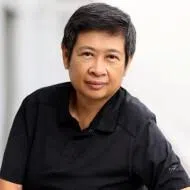
With these questions in mind, I approached Professor Ho Teck Hua, executive chairman of AI Singapore (AISG). When AISG was established in May 2017, he was its founding executive chairman, and in April 2023, he became the fifth president of Nanyang Technological University (NTU).
Prof Ho did not answer my question with jargon. Instead, he asked: “Have you travelled abroad recently? When passing through Changi Airport, you no longer need to scan your passport, right? Singapore is the first country in the world to implement large-scale passport-free clearance. Singapore residents can pass through immigration using only facial recognition and iris scanning, without needing to present their passports. Excluding queue time, the process takes only ten seconds. This is one example of our AI applications.”

The efficiency improvements we take for granted are powered behind the scenes by AI, and making AI practical and seamlessly integrated into people’s lives is a clear goal of AISG.
“AISG has three main goals: first, to create new job opportunities and make workers more efficient; second, to create new enterprises and make businesses more competitive; and third, to improve everyone’s quality of life, helping people live healthier and better lives.”
AI assistants no longer a dream
As 2024 ended, tech experts and companies predicted that 2025 will be the year when AI agents, or AI assistants, see full-scale development. In December, Google launched “Mariner”, an AI agent capable of browsing websites and assisting users with online shopping. Not to be outdone, OpenAI released its first AI agent application, “Operator”, on 24 January 2025.
AI agents function like personal assistants — they not only answer our questions but also perform various tasks, much like Jarvis, the assistant in the movie Iron Man. Jarvis is an advanced AI system that manages Iron Man’s mansion, armour and tech devices, while also providing strategic advice and avoiding risks. If AI agents are widely utilised, individuals could have multiple AI assistants, significantly boosting productivity and mitigating the challenges of slowing population growth.
Between 2016 and 2023, Singapore’s labour productivity grew by 2.4% annually. Prof Ho remarked that if every Singaporean had one AI assistant, the productivity growth rate could reach 5%. If everyone had nine AI assistants with different functions, Singapore’s effective population would not just be 6 million, but could feel like 60 million, in line with Singapore’s vision of becoming a smart nation.

Some scenarios from science fiction films might gradually become reality by 2025.
“Have you seen the movie Big Hero 6? In the film, there’s an adorable healthcare companion named BayMax — chubby, huggable and endearing. BayMax is an AI system whose sole purpose is to collaborate with humans to promote their health, rather than replace them. One unique feature of BayMax is that he’s programmed never to harm anyone.”
Developing a trustworthy human-centric AI
BayMax exemplifies AI coexisting with humanity. Since AI systems are trained by humans, if the data used to train them is biased or unfair, the AI system itself would not be fair or just. Therefore, transparency in AI systems is critical. People need to understand the principles and logic behind these systems to trust and adopt them with ease of mind.
To address humanity’s concerns about technology, it is essential to return to shared human values. One of AISG’s core principles is the development of responsible AI.
Prof Ho explained that a responsible AI system must first be human-centric, second, it must be fair; third, it has to be transparent, as it cannot operate as a “black box”; fourth, its logic must be understandable, so that users can understand the principles and logic behind any decision made by the system.
For Singapore, a small country striving to develop AI, credibility and responsibility are especially important. Data is the lifeblood of AI. Models rely on data to learn patterns and features that improve their accuracy and efficiency. Without sufficient high-quality data, it becomes challenging to build reliable AI systems.
AI for the region: SEA-LION
“The quality and quantity of data are both crucial, and quality has two factors: accuracy and authorisation. Some data is accurate, but if we don’t have authorisation, we can’t use it. As a small nation, our data volume is limited. That is certain.”
Singapore’s characteristic is pragmatism. In the knowledge that it cannot compete with larger nations with vast domestic markets, Singapore has embraced an open and cooperative mindset, to expand the opportunities available.
AI scientist and venture capitalist Lee Kai-Fu, who was featured in Lianhe Zaobao’s Future 365 interview series in 2024, noted in his book AI Superpowers: China, Silicon Valley, and the New World Order that the world may be divided into two digital power blocs, led by the US and China, in what could resemble a new Cold War. These two economic giants are expected to dominate AI development due to their larger pools of venture capital, greater numbers of scientists, and most importantly, access to vast amounts of data. High-quality data enables the creation of superior AI products, whose users would generate even more data.


Get the ThinkChina Weekly Newsletter
Insights on China, right in your mailbox. Sign up now.
By subscribing, I agree to SPH Media's Terms and Conditions and Privacy Policy.
Since its independence, Singapore has continuously strived to break free from the limitations and destiny of being a small nation. The key to this lies in adopting a broad vision and acting swiftly and flexibly. In the realm of AI model development, Singapore refuses to confine itself to the large models developed by others. Instead, it recognises its unique position in Southeast Asia and aims to create its own large language model, similar to ChatGPT.
With the support of Singapore’s National Research Foundation, AISG began developing a large language model tailored specifically for Southeast Asia at the end of 2023. This model, named SEA-LION (Southeast Asian Languages in One Network), is designed to train machines based on Southeast Asian languages.
The need for localised regional AI
Prof Ho is especially excited when discussing SEA-LION. He explained in Mandarin during the interview: “SEA-LION stands for Southeast Asian Languages in One Network. It’s a platform that integrates many different languages, and it is customised for the Southeast Asian region. Our goal is to better represent the region’s rich cultural and linguistic diversity.
“Existing large language models like ChatGPT use data primarily sourced from Western countries, and they often fail to capture the nuances of Southeast Asian languages. As a result, when we ask these models certain questions, they sometimes give irrelevant answers because their data doesn’t come from our local or Southeast Asian contexts.”
While Singapore’s population is only about six million, the broader Southeast Asian region has nearly 700 million people speaking approximately 1,200 languages. Covering all these languages is undoubtedly a daunting task, but someone has to take the lead. Over time, this project is expected to become a critical AI resource for the region.
Prof Ho expressed satisfaction with SEA-LION’s progress over the past year. As an open-source project, it provides a platform for countries in the region. For instance, Indonesia and Thailand, two major regional powers, have used SEA-LION as the foundation for building their localised large language models, Sahabat and WangchanLION.

He explained that SEA-LION not only offers neighbouring countries a platform to develop their own large models but also benefits Singapore through collaboration. These partnerships have brought in a wealth of accurate and valuable data, significantly contributing to the improvement of SEA-LION.
Currently, SEA-LION supports 11 commonly used languages in the Southeast Asian region: English, Mandarin, Burmese, Filipino, Khmer, Lao, Malay (including Indonesian and Malaysian), Tamil, Thai, Vietnamese and Sumatran.
Beyond receiving national-level support, SEA-LION has also attracted the attention of major tech companies like Google and Microsoft, which have begun recognising its potential. With the combined efforts of corporate and governmental partnerships, both the quantity and quality of SEA-LION’s data have been significantly enhanced. Prof Ho is confident that SEA-LION will become the most comprehensive large language model tailored to Southeast Asia.
“Singapore is a place that people generally trust, especially during times of global geopolitical division. If Singapore can serve as a bridge in Southeast Asia, it is partly because of our responsible management approach, which has earned praise.”
The impact of US-China AI competition on Singapore
On his fourth day in office, US President Donald Trump signed an executive order related to AI, declaring the goal to “make America the world capital in artificial intelligence”. He also instructed an interagency task force to draft an “AI action plan” within 180 days to maintain and strengthen the US’s global AI dominance, aiming to boost economic competitiveness and national security.
In the AI race, the US holds a clear advantage in technological innovation and investment scale, while China leads in application scenarios, population size and industrial clustering. These two AI superpowers have left other nations trailing far behind. While Singapore ranks third in the Global AI Index, its score still lags significantly behind that of the US and China.
As competition between the US and China in the AI field intensifies, what impact will it have on Singapore and the AI strategies of other nations?

Prof Ho said: “In the competition between the two major powers, the US and China, Singapore has always maintained a neutral stance. We welcome AI talent from around the world to come here and develop their careers. Here, a talented individual can collaborate with US experts, China experts, as well as Europeans and Indians.
“Ultimately, we have to maintain neutrality and transparency. Every AI system we develop is not designed to serve the interests of any one country but to benefit the people at large, especially Singaporeans. We are also willing to share our innovations with our neighbours. I believe this places us in a favourable position amid the competition between major powers, because we truly can be a trusted hub for international collaboration.”
Prof Ho said over the past five years, Singapore’s open-door policy for global talent has attracted many top experts. While Singapore cannot compete comprehensively with the front-runners in the AI race, it can excel in specific areas and aim to be the best in the world in those domains. By focusing on these niches, maintaining a spot in the global AI top five remains within reach.
“Mainly it’s about being number one or two in a few areas. How do we do that? One area is ‘responsible AI’. We also do well in AI governance, thanks to a robust framework. Companies developing or implementing AI systems are guided by principles to ensure they stay within ethical boundaries and avoid missteps.”
For Singapore to claim a share of cutting-edge technological advancements, it does not necessarily need to lead in every aspect. What matters is having unique strengths. In fields such as AI technology, chip manufacturing or quantum computing, Singapore should invest strategically to ensure it offers innovative solutions that attract collaboration.
“We aim to be an indispensable participant. It’s like playing an important supporting role in a movie. You may not be the protagonist, but as a key supporting character, the story wouldn’t feel right without you.”
This article was first published in Lianhe Zaobao as “不必争主角 配角也精彩”.
Related: Chinese AI startups make gains in challenge to US-based OpenAI | How China plays catch-up in the AI race with US
Popular This Month
Get the ThinkChina Weekly Newsletter
Insights on China, right in your mailbox. Sign up now.
By subscribing, I agree to SPH Media's Terms and Conditions and Privacy Policy.